Storage Near Beaver Lake, Arkansas: Boat, Household, and Seasonal Storage Guide
Use this guide to compare trailer access, route to the water, covers, moisture control, access hours, seasonal gear, pricing, and what to ask before renting boat storage.
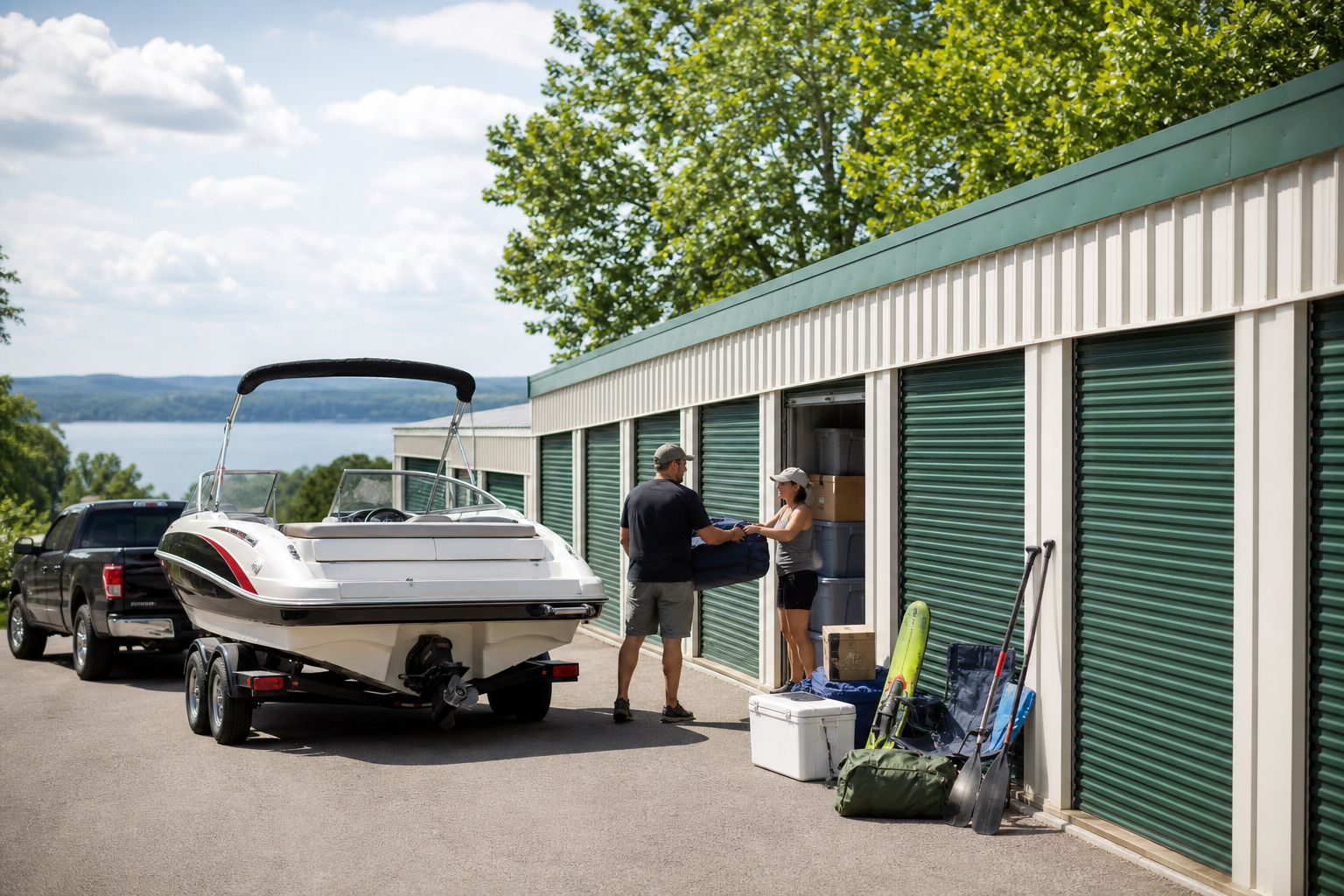
Boat, household, and seasonal storage around one of Northwest Arkansas' busiest lakes.
Beaver Lake storage is mostly a boat-and-gear problem: a trailered boat needs length and drive-up access, while life jackets, electronics, and coolers do better indoors and out of the humidity. This guide walks through picking the smallest unit that actually fits your rig, deciding when climate control is worth it, choosing drive-up over indoor based on your route to the ramp, and reading price, fees, and access hours before you sign. It also covers the questions worth asking a facility so your off-season stretch does not turn into a spring cleanup project.
What matters most
Use the article as a decision filter: choose the smallest unit that comfortably fits your load, use climate control for wood, electronics, documents, photos, and fabrics, prioritize access that matches your real schedule, and compare regular rates and fees before trusting the cheapest promotion.
Prepare the boat before it sits
A boat that goes into storage wet and full sits and stews. Before it goes in, stabilize a full fuel tank so condensation can't build inside a half-empty one, run the engine long enough to circulate that stabilizer, and disconnect or pull the battery so it isn't slowly draining for months. Drain the bilge and livewells, let the interior dry fully, and prop or crack the cover so trapped moisture can escape rather than growing mildew on your seats. Chock the trailer and take weight off the tires if it will sit a full season. These steps decide whether spring starts with a launch or a repair bill.
- Add marine fuel stabilizer and run the engine to circulate it
- Disconnect or remove the battery and store it charged
- Drain bilge and livewells, then dry the interior before covering
- Vent the cover slightly instead of sealing it airtight
Snap a photo of the fuel gauge and battery terminals the day you store it. When you come back weeks later, you'll know instantly whether something drained or drifted instead of guessing.
Keep lake gear dry and grouped together
Boat gear scatters fast: dock lines in one bin, life jackets stuffed under a seat, coolers in the garage, the good speaker in the house. Storing it as one grouped kit in a dry space means you load in minutes instead of hunting. Life jackets and ropes hold moisture and mildew if they go in damp, so let them dry before they're bagged. Arkansas summer humidity is the real enemy here — sealed bins with the air squeezed out protect fabric and foam better than open shelves. Keep a labeled 'go' bin of the small stuff you always forget: sunscreen, a spare line, a first-aid kit, and a charged handheld light.
- Group gear into labeled, sealable bins by function
- Dry life jackets and dock lines before storing
- Keep a small 'go' bin of easily forgotten essentials
- Store trailer spare and tools alongside the gear
Store the trailer's spare tire, jack, and lug wrench with the gear, not loose in a garage. A blowout on the way to the ramp is the one failure that ends a lake day before it starts.
Choose access around your route to the water
Beaver Lake stretches across Northwest Arkansas with ramps and marinas near Rogers, Garfield, and Eureka Springs, so the storage spot that saves you time is the one on the way to your ramp — not the closest one to home. A unit five minutes off your launch route means you hitch up and roll straight to the water. Think about the direction you actually drive: pulling a trailer through downtown or up a tight, winding grade adds real time and stress. Drive-up outdoor access with a wide pull-through lane matters most here, because backing a trailer into a narrow indoor bay before sunrise is nobody's idea of a good start.
- Pick a site on your regular route to the ramp
- Favor wide pull-through lanes for trailer maneuvering
- Avoid tight indoor turns for anything on a trailer
- Confirm gate and access hours match early launches
Do a dry run towing the empty trailer from the storage site to your usual ramp once before committing. A route that looks fine on a map can hide a low bridge, a tight turn, or a no-trailer stretch.
Compare convenience with protection for the off-season
Off-season is when the tradeoff between cheap and protected gets real. Open outdoor parking is the least expensive way to park a hull, but it takes the full brunt of Arkansas heat, storms, and UV on your cover and gelcoat. Covered or enclosed drive-up costs more and shields the boat from sun and hail. A separate small climate-controlled unit for electronics, batteries, and PFDs is a modest add-on that pays for itself the first time you avoid a corroded connector or a mildewed seat. Read the price the same way you'd read a slip fee: know the monthly rate, any admin or gate fees, and whether the intro rate jumps after a few months.
- Open parking is cheapest but exposes the cover and hull
- Covered or enclosed shields from sun, hail, and storms
- A small climate-controlled unit protects gear and electronics
- Confirm fees and whether the intro rate increases later
If you're torn between covered parking and open, price a boat cover and UV-protectant against the monthly difference. Sometimes a good cover plus cheaper parking beats a pricier covered space; sometimes it doesn't — run the numbers before assuming.
Quick summary
| Decision | What to check | Why it matters |
|---|---|---|
| Unit size | Total length tongue-to-platform plus 3-4 ft | Spec length ignores the trailer and maneuvering room |
| Access type | Drive-up pull-through vs indoor bay | Trailers don't back easily into tight indoor turns |
| Climate control | Where electronics, batteries, and PFDs will sit | Arkansas humidity corrodes and mildews gear, not the hull |
| Access hours | Earliest gate entry time | Dawn launches need entry before business hours |
| Price and fees | Rate, admin/gate fees, and rate increases | A teaser rate can rise once the season starts |
Storage numbers worth checking
Use these numbers as decision anchors before comparing facilities. The goal is not to guess a perfect unit — it is to compare the same details across options.
List largest items, box count, and aisle needs.
Use these as comparison anchors.
Monthly rate, promo length, required fees.
Drive-up convenience vs. indoor protection.
| Check | What to compare | Why it matters |
|---|---|---|
| 5×10 | Boxes, small bedroom, seasonal items | A small unit can save money if it truly fits |
| 10×10 | Apartment contents or household overflow | Often a safer middle option for mixed items |
| 10×20 | Multi-room moves or large equipment | More room can reduce loading frustration |
| Climate control | Sensitive vs. durable belongings | Arkansas heat and humidity change the risk |
StorageGuide verdict
Use the article as a decision filter: choose the smallest unit that comfortably fits your load, use climate control for wood, electronics, documents, photos, and fabrics, prioritize access that matches your real schedule, and compare regular rates and fees before trusting the cheapest promotion.
Storage FAQs
What size unit do I need for a boat on a trailer?
Measure from the trailer tongue to the swim platform or motor, not the boat's listed hull length, then add three to four feet for maneuvering and walking room. Outdoor drive-up or covered parking sized to that total is usually easier than squeezing into an enclosed bay.
Do I need climate control for boat storage near Beaver Lake?
The hull itself generally doesn't, but sensitive gear does. Arkansas heat and humidity are hard on life jackets, ropes, electronics, and batteries, so a small climate-controlled unit for that gear is often worth more than climate-controlling the whole boat.
Is drive-up or indoor access better for a trailered boat?
Drive-up with a wide pull-through lane is usually best for anything on a trailer, since backing into a narrow indoor bay is slow and awkward. Indoor makes more sense for loose gear you retrieve often and want fully protected.
What should I ask before renting?
Confirm the exact unit length, whether access is drive-up or indoor, the earliest gate hours, the full monthly rate including any admin or gate fees, and whether an introductory rate increases later in the season.
How do I prep my boat if it will sit all off-season?
Fill and stabilize the fuel tank, run the engine to circulate it, remove or disconnect the battery, drain the bilge and livewells, dry the interior, and vent the cover so moisture can escape instead of building mildew.
Find dry, easy-access storage near Beaver Lake
Compare unit sizes, access types, and terms so your boat and gear are ready for the next weekend on the water.