Boat Storage Guide for Arkansas Lake Owners
Use this guide to compare trailer access, route to the water, covers, moisture control, access hours, seasonal gear, pricing, and what to ask before renting boat storage.
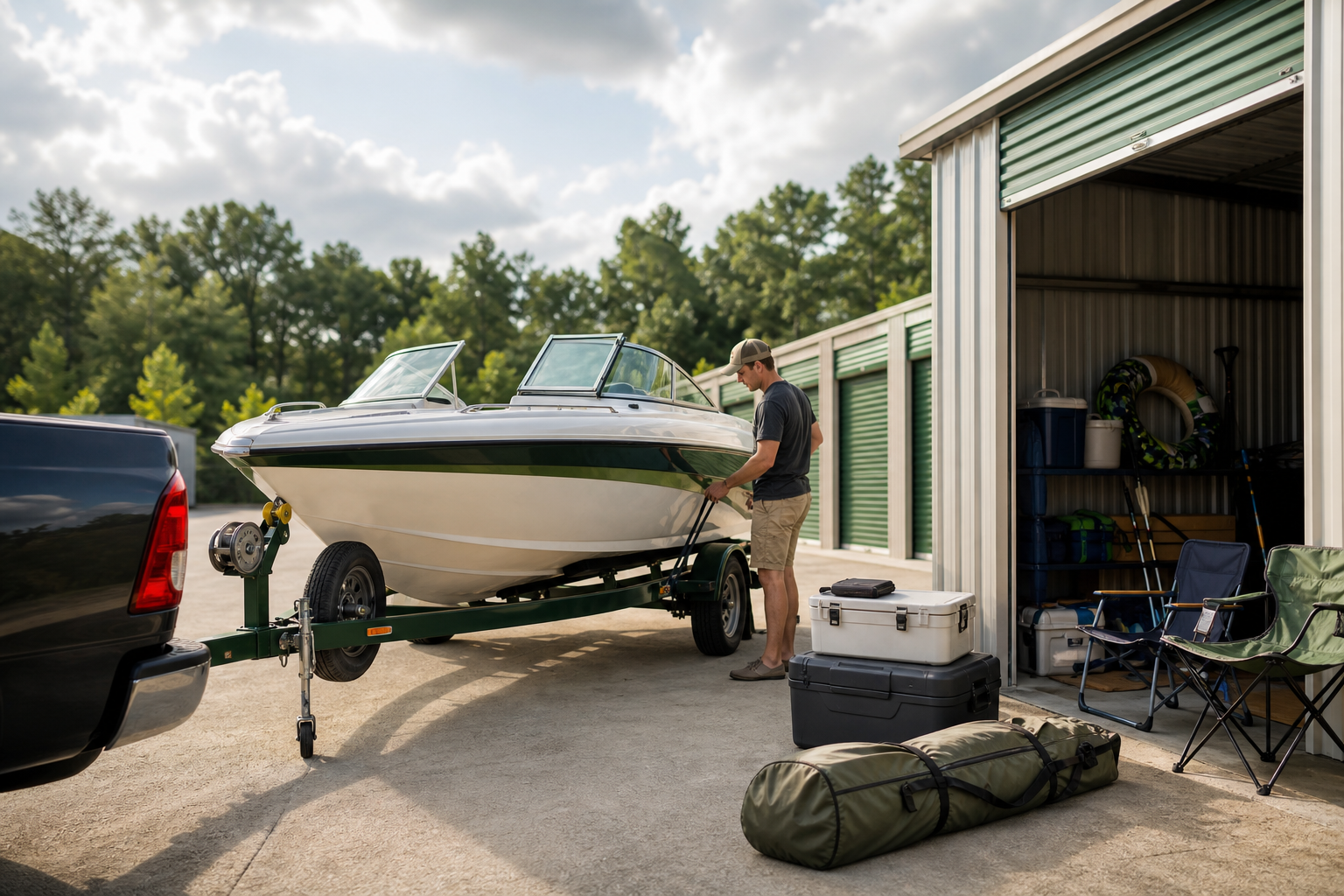
How to store a boat and lake gear in Arkansas so it stays dry, organized, and ready for the next weekend on the water
Most Arkansas lake owners don't need a fancy setup for the off-season, but they do need to match the unit to the boat and trailer, decide how much protection the gear needs, and pick access that fits the route to the water. This guide walks through prepping the boat before it sits, keeping life jackets and lines dry, choosing between drive-up and indoor access, and reading the fine print on size, climate control, price and fees, and access hours before you sign.
What matters most
Use the article as a decision filter: choose the smallest unit that comfortably fits your load, use climate control for wood, electronics, documents, photos, and fabrics, prioritize access that matches your real schedule, and compare regular rates and fees before trusting the cheapest promotion.
Prepare the boat before it goes into storage
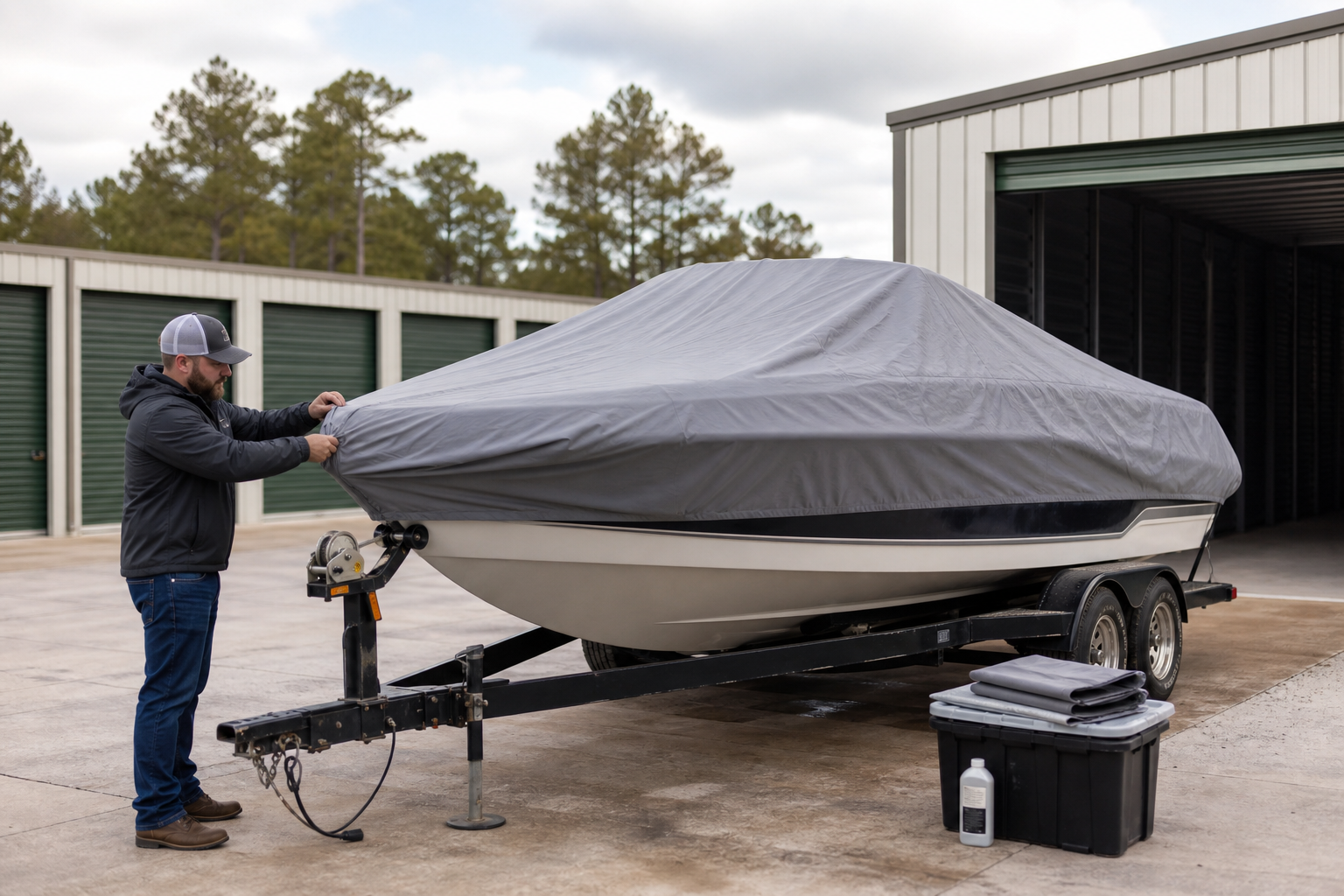
A boat that gets parked wet and full of fuel doesn't come out ready. Before the unit door closes for weeks or months, top off the fuel tank and add a marine fuel stabilizer so condensation and oxidation don't build up as temperatures swing. Pull the battery and store it somewhere it can stay charged rather than draining in a hot unit, run the bilge dry, and let carpet, cushions, and the hull fully air out so you're not sealing in moisture. A breathable cover beats a tight tarp, which traps condensation against the gelcoat. Do this once at the start of the off-season and retrieval becomes a load-and-go instead of a repair day.
- Add marine fuel stabilizer and run the engine briefly to circulate it
- Remove the battery and keep it on a maintainer off-site
- Dry the bilge, hull, and cushions before covering
- Use a breathable cover, not a sealed tarp
Snap a photo of the trim, drain plug, and battery terminals the day you store it. When you pull the boat out months later, that photo is your fastest check that nothing was left open or disconnected.
Keep lake gear dry and grouped so it loads fast
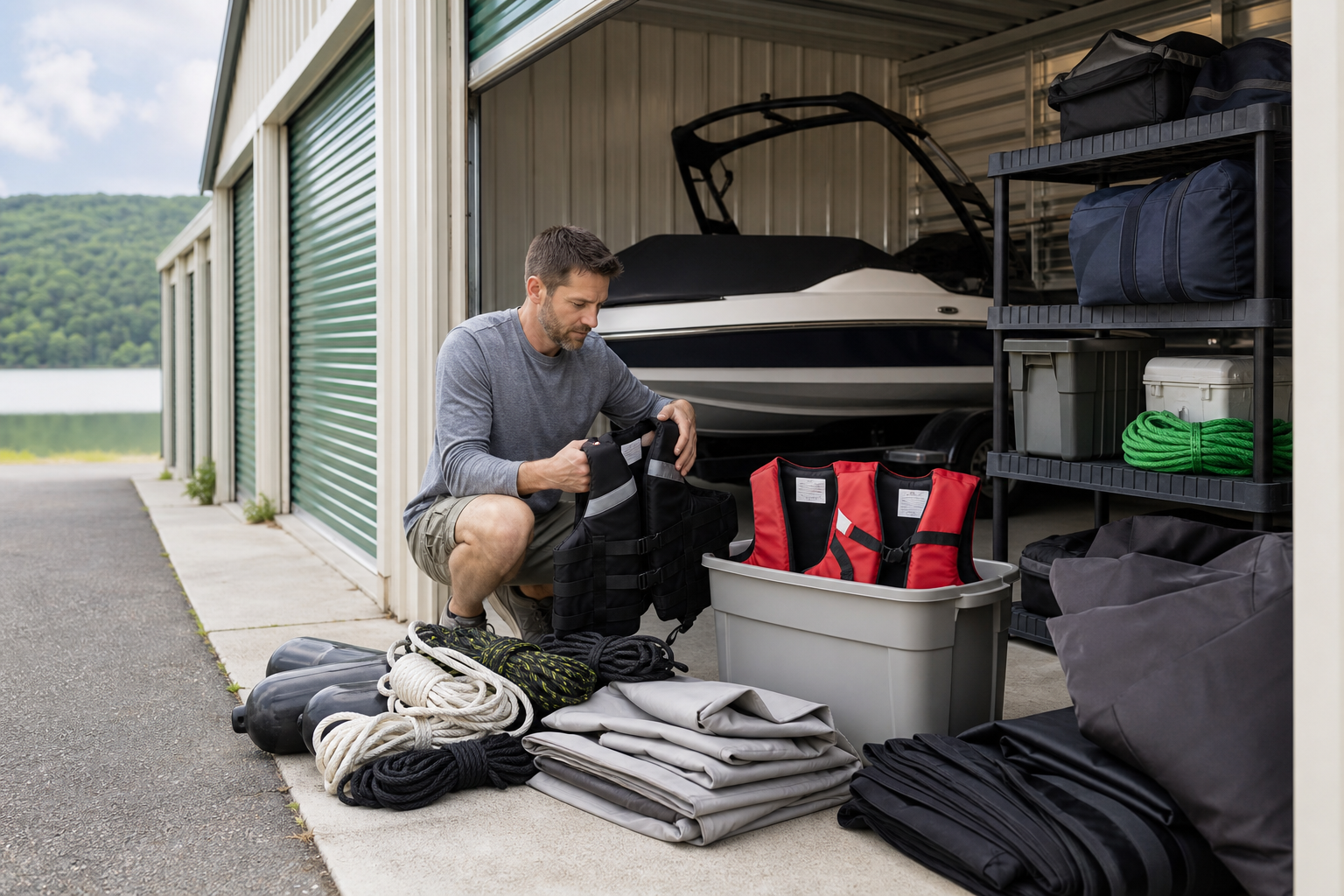
The boat is the easy part to remember; it's the loose gear that turns a lake morning into a scavenger hunt. Life jackets, dock lines, and coolers hold moisture and mildew in Arkansas humidity, so store them in vented bins rather than sealed plastic that sweats. Group everything by when you use it: a launch bin (lines, fenders, plug, keys), a safety bin (life jackets, first aid, flares), and a comfort bin (towels, coolers, sunscreen). Stack them where you can reach them without climbing over the trailer tongue. Life jackets keep their shape and buoyancy longer when hung or loosely stacked instead of crushed under heavier gear.
- Use vented bins, not sealed plastic, to fight mildew
- Hang or loosely stack life jackets to protect buoyancy
- Keep a toss-in bag of moisture absorbers with the gear
- Store dock lines coiled and dry to prevent rot
Label bins on the end that faces the door, not the top. In a stacked unit you read the ends first, and end-labeled bins let you grab the launch bin without unstacking the whole shelf.
Choose access around your route to the water
Where and how you get the boat out matters more than most owners expect. If you launch often in the warm months, a drive-up unit with a wide approach lets you hitch up and pull straight out without maneuvering a trailer through tight indoor aisles. Look at gate and access hours against when you actually leave for the lake — an early Saturday launch is useless if the gate opens at 8. Consider the facility's position relative to your usual ramp: a unit slightly farther from home but on the way to the water can save a backtrack every trip. Wide turning room, a pull-through lane, and a level surface matter far more for a trailer than they do for boxes.
- Favor pull-through or wide drive-up lanes for trailers
- Confirm access hours cover early weekend departures
- Pick a location that sits on your route to the ramp
- Check turning radius and surface level, not just unit size
Back the trailer in once during your tour, before you rent. If the approach angle or gate width makes you sweat with an empty trailer, it will be worse loaded and in a hurry on a Saturday.
Weigh convenience against protection for the off-season
For a long winter sit, protection usually wins over pure convenience. Outdoor and drive-up spaces are the cheapest and easiest to pull in and out of, but they leave the boat exposed to Arkansas heat, storms, and UV. Covered spaces block sun and most weather at a middle price. Fully enclosed or climate-controlled units cost more but hold temperature and humidity steady, which protects electronics, upholstery, and anything that molds during a muggy off-season. A useful rule: match the level of protection to how sensitive and expensive the boat and its gear are, and to how long it will sit untouched. A short off-season with a well-covered boat may not justify climate control; a five-month sit with marine electronics aboard often does.
- Outdoor/drive-up: cheapest, most exposed to sun and storms
- Covered: blocks UV and most weather at mid price
- Enclosed/climate-controlled: steadiest for electronics and upholstery
- Match protection to sit length and gear value
Move only the sensitive items indoors if a full climate-controlled boat unit stretches the budget. Store the boat outdoors under cover and keep electronics, life jackets, and cushions in a small climate-controlled locker nearby — you protect what matters without paying to condition the whole hull.
Quick summary
| Decision | What to check | Why it matters |
|---|---|---|
| Unit size | Boat length plus trailer tongue and one walk-around side | Undersizing means scraped gelcoat and no room for gear; oversizing wastes money |
| Access type | Drive-up/pull-through vs. enclosed, plus turning room | A trailer needs a clean approach, not tight indoor aisles |
| Climate control | Whether electronics, upholstery, or fabrics stay aboard | Arkansas heat and humidity mildew gear during long sits |
| Access hours | Gate open times vs. your earliest launch | An early Saturday start fails if the gate opens late |
| Price and fees | Total monthly rate, deposits, length surcharges | Teaser rates can hide trailer-length or admin fees |
Storage numbers worth checking
Use these numbers as decision anchors before comparing facilities. The goal is not to guess a perfect unit — it is to compare the same details across options.
List largest items, box count, and aisle needs.
Use these as comparison anchors.
Monthly rate, promo length, required fees.
Drive-up convenience vs. indoor protection.
| Check | What to compare | Why it matters |
|---|---|---|
| 5×10 | Boxes, small bedroom, seasonal items | A small unit can save money if it truly fits |
| 10×10 | Apartment contents or household overflow | Often a safer middle option for mixed items |
| 10×20 | Multi-room moves or large equipment | More room can reduce loading frustration |
| Climate control | Sensitive vs. durable belongings | Arkansas heat and humidity change the risk |
StorageGuide verdict
Use the article as a decision filter: choose the smallest unit that comfortably fits your load, use climate control for wood, electronics, documents, photos, and fabrics, prioritize access that matches your real schedule, and compare regular rates and fees before trusting the cheapest promotion.
Storage FAQs
What size unit do I need for a boat and trailer?
Measure the boat on the trailer from the tip of the tongue to the outboard or swim platform, then add a few feet of clearance to walk one side and open compartments. Many trailered boats fit a 10×20 to 12×40 range, but go by your actual measured length rather than the boat's advertised length, which ignores the trailer.
Is climate control worth it for boat storage in Arkansas?
It depends on what stays aboard and how long it sits. For a short off-season with a well-covered boat and no electronics inside, covered or enclosed storage is often enough. For long sits with marine electronics, upholstery, or life jackets aboard through humid summers, climate control protects those items from mildew and heat damage.
Drive-up or indoor access for a trailered boat?
Drive-up and pull-through spaces are easier for hitching and launching often, so they suit active warm-season use. Indoor or enclosed units offer more protection but can mean tighter aisles and turning. If you launch frequently, prioritize a wide, level drive-up approach; if the boat mostly sits, lean toward enclosed protection.
What should I ask before renting a boat unit?
Confirm the total monthly price including any deposit and trailer-length surcharge, the exact access and gate hours, the maximum allowed length, whether the approach and turning room fit your trailer, and whether the unit is outdoor, covered, or climate-controlled. Verify these against your own route and launch schedule before signing.
How do I keep gear from mildewing over the off-season?
Dry everything before it goes in, use vented bins instead of sealed plastic, hang or loosely stack life jackets, coil dock lines dry, and add moisture absorbers to the bins. Air the boat's bilge and cushions out fully and cover with a breathable cover so condensation doesn't get trapped.
Find a boat-friendly storage unit near your Arkansas lake
Compare unit sizes, access types, and climate options against your route to the water, then pick the space that keeps your boat and gear ready for the next weekend.